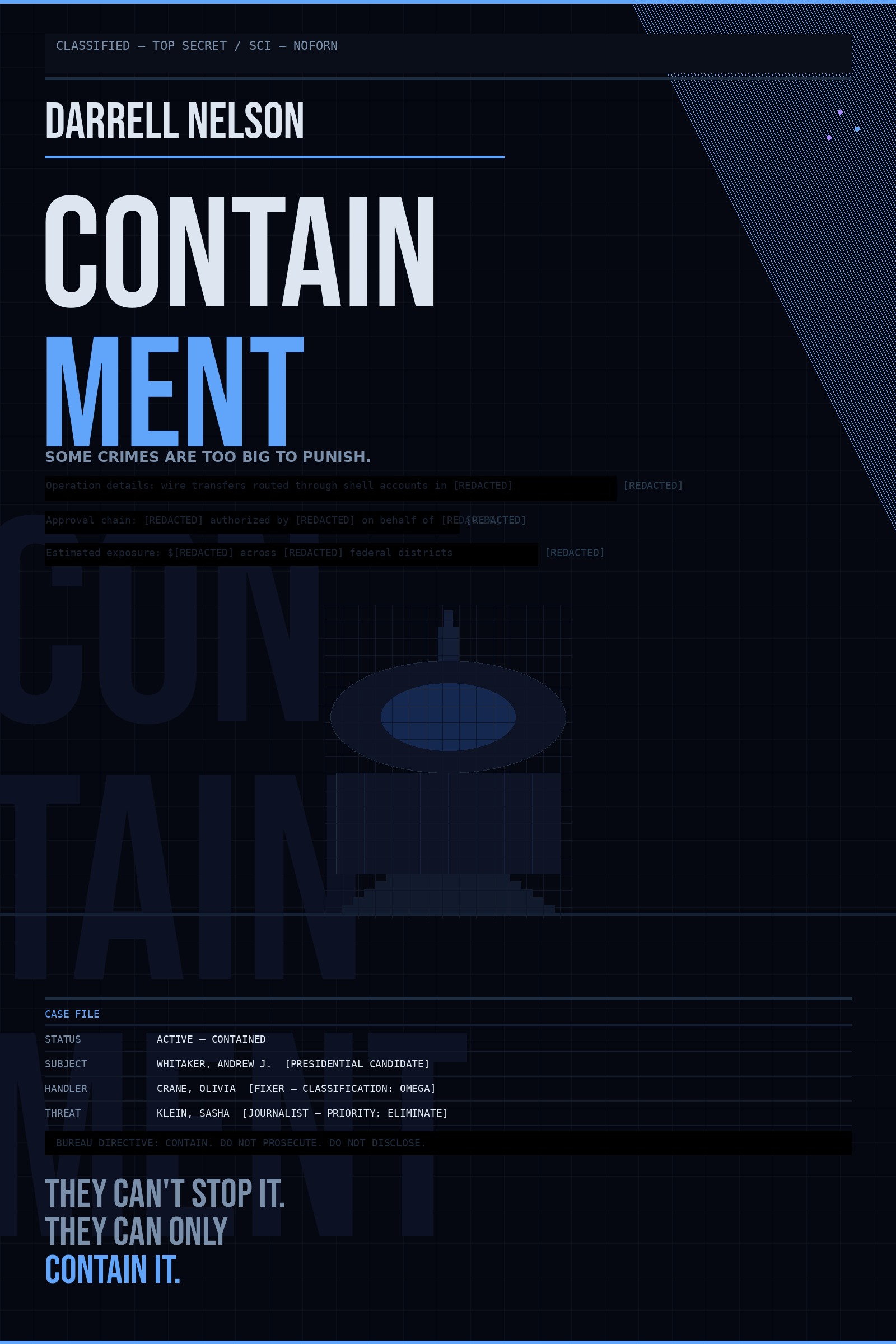
A broke presidential candidate bankrolls his rise through precision bank heists—until a relentless reporter and an FBI agent discover the Bureau would rather contain the truth than stop it.
The Story.
Andrew Whitaker is the perfect candidate—until you see the balance sheet. With his campaign collapsing and the primaries closing fast, he signs off on a plan no one will say out loud: precision bank heists designed to refill his war chest without leaving fingerprints. The hits are clean. The money is immediate. The country feels… relieved.
Then Sasha Klein notices the timing. The same week Whitaker's cash drought ends, the robberies begin. Her reporting draws the attention of Special Agent Ellen Rourke, who discovers the Bureau isn't hunting the crew—it's containing the fallout. Stability, at any cost.
Now a fixer named Olivia Crane is rewriting records, reputations, and bodies to keep Whitaker's rise intact—and to make anyone who threatens the story disappear.
From donor salons in D.C. to the fluorescent backrooms where policy becomes pressure, CONTAINMENT is a chilling political thriller about how power keeps the lights on—and who gets ground up in the machinery.
Power that survives exposure. The machine that keeps going anyway. What it costs to refuse to look away.
Investigative journalist. Protagonist. Refuses to be managed, discredited, or erased.
Presidential contender. And the containment machine running behind him.
The fixer. The one who makes problems—and people—disappear.
Chapter One.
Chapter 1
The Candidate
Andrew Whitaker had learned how to smile in photographs when he was still young enough to believe the camera knew the truth.
Now he smiled because it was a weapon.
He stood under the ballroom lights at the Jefferson Hotel, shoulders back, chin level, grin tuned to the exact frequency that made donors feel like their money was safe in his hands. He'd done this a thousand times: grip the mic, take a half-beat for applause, laugh at something that wasn't funny, promise a future that no one believed in anymore.
A campaign was a kind of consensual hallucination. You asked people to pretend you were the solution. They asked you to pretend you weren't like every other politician who'd ever asked.
Whitaker was good at pretending.
The room was thick with perfume and the sour undertone of cheap wine, the air heavy over worn carpet. The crowd wore the uniform of modern influence: dark suits, bright teeth, watches expensive enough to buy a year of groceries without blinking. A woman in the front row held her phone up like a votive candle and mouthed you're going to win at him as if she'd just given communion.
"I'm not losing."
On the dais behind him, a banner read:
Restore had tested better than renew. It implied the past had been better, even if nobody could agree on when. It let people borrow nostalgia without admitting they were scared.
Whitaker leaned toward the microphone, softening his voice. The crowd leaned with him.
"My friends," he said, and watched them drink it in. "I don't need to tell you what's at stake."
Laughter. Nods. A few murmurs of agreement—low, serious, ritualistic.
"I travel this country," he continued, "and I meet people who are tired. They're tired of chaos. They're tired of being told that everything is fine when they can feel it falling apart."
A donor in the second row—gray hair, shark smile—clapped hard, the kind of applause meant to be seen. Whitaker clocked him automatically. Harlan Finch. Hedge fund. East Coast. Reliable. Always wanted a photo. Always wanted to feel like he owned a piece of you.
Whitaker's campaign manager, Marcy, stood near the side wall with her arms folded. She didn't clap. She watched the room the way a firefighter watched smoke.
Whitaker's eyes flicked toward her for a fraction of a second. She gave him the smallest nod: keep going.
He did.
"We're going to restore order," Whitaker said.
The words tasted like ash in his mouth. For half a second—less than a breath—he felt the truth trying to claw its way out: that order was a lie people told themselves when they couldn't face the chaos, that his entire job was to make them believe the lie harder, deeper, until they couldn't remember what truth had felt like. His tongue moved toward it. He swallowed it back down where he'd learned to bury everything that mattered.
"We're going to restore order," Whitaker said. "We're going to protect our families. We're going to defend what makes this country—"
His voice caught deliberately, a practiced break. Emotion, manufactured and well-timed. It played beautifully on camera.
"We're going to defend what makes us American."
Applause rose, thick and warm.
Whitaker smiled wider, and inside the smile was a quiet calculation: This is the part they always buy.
He finished strong—flags, faith, small-town grit—and stepped back as the room surged to its feet. He shook hands. He hugged strangers like he'd known them for years. He accepted compliments like they were inevitable.
Then he moved offstage and into the service corridor behind the ballroom, where the lighting was harsh and nobody tried to pretend.
His smile vanished the moment the curtain closed. Marcy followed him in, fast.
"You killed it," she said.
Whitaker nodded, still breathing a little hard. The microphone had been too hot. His palms were damp.
"Finch wants five minutes," Marcy added. "Also the Wexler couple. They're pissed about the new burn rate."
Whitaker didn't answer right away. He leaned against a wall and closed his eyes for a second. He heard the ballroom behind him—applause fading into chatter, money turning into certainty.
A staffer handed him a bottle of water. Whitaker drank half of it in one swallow, then wiped his mouth with the back of his hand.
"Burn rate," he repeated.
Marcy exhaled. "We're bleeding. You know we're bleeding."
Whitaker opened his eyes.
"How much?" he asked, already knowing the answer would be worse than he could afford.
Marcy didn't like saying numbers out loud. Numbers made things real.
But she said it anyway.
"We have twelve weeks," she said. "Maybe ten if the super PAC doesn't—"
Whitaker cut her off with a raised hand. "They will."
Marcy's jaw set. "They might. If you keep your momentum. If nothing hits us. If donors don't get spooked."
Whitaker watched her.
"If," he said.
Marcy looked away for half a beat—human, tired—then looked back.
"You can't run a presidential campaign like a congressional campaign," she said. "We're not just buying ads. We're buying a country."
Whitaker laughed once. It wasn't the charming laugh he used onstage.
"Jesus," he said.
Marcy didn't laugh with him.
"You've got private money, sure," she continued. "But private money's cowardly. They all want the same thing: proof. They want to see you can win."
Whitaker's jaw clenched. Victory was a feedback loop. You had to look inevitable to become inevitable.
And inevitability cost money.
He pushed off the wall.
"How much do we need?" he asked, already knowing the answer would make him hate her.
Marcy hesitated.
"Two hundred million," she said. "To compete through Super Tuesday. Three if we want to choke the field."
Whitaker stared like she'd just told him the Earth was made of glass.
"Three hundred million," he repeated.
That was the public number. The private number was smaller and uglier: enough untraceable runway to keep vendors paid, operatives moving, and the story intact—until the legitimate money came back.
Marcy shrugged, almost apologetic.
"You want the nomination? That's the price."
"You're asking me to build an aircraft carrier out of fucking bake sales," he said.
Marcy's eyes sharpened at the language—Whitaker rarely swore in front of staff—but she didn't flinch.
"This is the job," she said.
Whitaker nodded slowly, shoulders squared.
Then he said, almost to himself:
"I'm not losing."
Marcy stared at him.
"No," she agreed. "You're not."
A beat where neither of them spoke. The quiet truth underneath every campaign, every speech, every handshake: If you don't win, you don't matter.
Marcy checked her phone, then looked up.
"Finch is waiting," she said.
Whitaker rolled his shoulders once like he was loosening a suit of armor.
"Let him," he said.
Marcy blinked.
Whitaker leaned close and lowered his voice.
"Tell him I'll see him tomorrow," Whitaker said. "Tell him… I'm on a plane."
Marcy stared, confused. "Plane to where?" she asked.
Whitaker's mouth curved into a small, private smile that didn't reach his eyes.
"Somewhere," he said, "we can fix the numbers."
He walked down the corridor toward the exit, leaving the applause behind him like a skin he could shed whenever he needed. He pushed through the back door into the cold night air.
The city was damp, the streetlights throwing halos in the mist. A black car waited at the curb.
Whitaker paused before getting in. He looked back at the hotel. At the ballroom windows. At the people inside raising glasses to his victory that hadn't happened yet.
Briefly he felt something close to grief. Not for the country. For himself. For the version of him that had once believed he could win the right way.
Then the feeling passed, like everything did.
Whitaker got into the car.
And the campaign rolled forward into the dark, toward whatever had to happen next.
Chapter 1 of 81 · ~102,000 words
For Agents & Producers.
Materials available on request.
What's Available
Full query letter, complete synopsis, and sample pages—ready to send on request. Just reach out.
request materialsAdaptation
Written with screen in mind from the start. Cinematic pacing, sharp dialogue, ensemble cast. Fits feature or limited series.
press kitAuthor
Midwest-born. LA-based. One complete novel and more in development. Dark, character-first, politically sharp.
about darrell